Thinkers and political figures
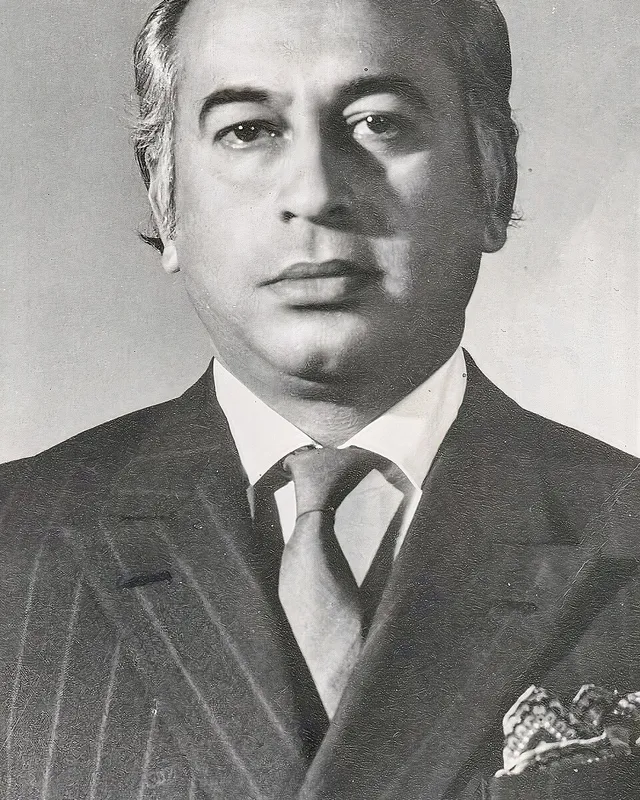
Portrait: Government of Pakistan, via Wikimedia Commons (opens in a new tab) · Public domain
Zulfikar Ali Bhutto
- Country
- Pakistan
- Era
- 1928–1979
- Tradition
- Islamic socialism, populism
Founder of the Pakistan Peoples Party who nationalised much of the economy under the slogan of Islamic socialism, gave Pakistan its 1973 constitution and its nuclear programme, and was hanged by the general he had promoted.
01
Documented positions
Documented positions come from the sources listed. Similarity is this project’s inference from those positions, and is a much weaker claim.
- Nationalised banks, insurance, heavy industry and later flour and rice mills under a programme he called Islamic socialism
- Introduced land reform reducing ceilings on individual holdings, with limited practical effect
- Framed and passed the 1973 constitution, which remains the basis of Pakistan’s parliamentary system
- Launched Pakistan’s nuclear weapons programme after the 1971 defeat
- Declared Ahmadis non-Muslim by constitutional amendment in 1974 under pressure from religious parties
- Used the Federal Security Force against political opponents and presided over rigged elections in 1977
02
Where it sits on each dimension
Wealth and inequality
18
RedistributionMarket outcomes
Evidence: Well documented
The state in the economy
16
Active stateLimited state
Evidence: Well documented
Personal liberty
30
Collective orderIndividual freedom
Evidence: Documented
Tradition and change
58
ContinuityReform
Evidence: Documented
Nation and the world
84
InternationalistNationalist
Evidence: Well documented
Religion and the state
62
Secular stateReligion in public life
Evidence: Documented
Power and its limits
28
Concentrated authorityChecks and pluralism
Evidence: Documented
Dimensions left unscored, for want of evidence: Environment and growth, Crime and punishment
Sources
- Zulfikar Ali Bhutto, The Myth of Independence · 1969
- Stanley Wolpert, Zulfi Bhutto of Pakistan · Oxford University Press · 1993
Last verified: