Thinkers and political figures
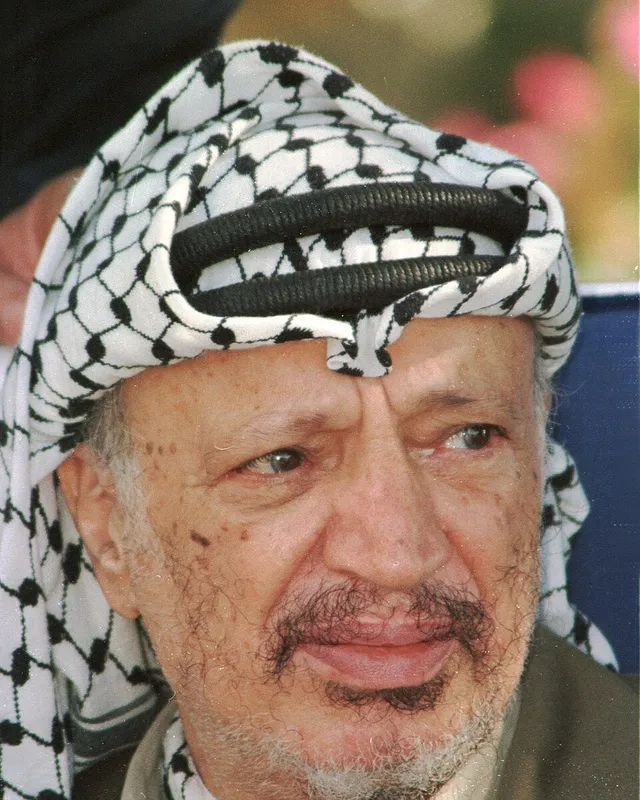
Portrait: Dan Hadani Archive, National Library of Israel, via Wikimedia Commons (opens in a new tab) · Creative Commons Attribution 4.0
Yasser Arafat
- Country
- Palestine
- Era
- 1929–2004
- Tradition
- Palestinian nationalism
Founder of Fatah and chairman of the PLO for thirty-five years, who moved the Palestinian movement from armed struggle to negotiation, signed the Oslo Accords, and died besieged in Ramallah with no state achieved.
Documented positions
Documented positions come from the sources listed. Similarity is this project’s inference from those positions, and is a much weaker claim.
- Founded Fatah and built the PLO into the recognised representative of the Palestinian people
- Directed and sanctioned armed operations, including attacks on civilians, during the 1960s and 1970s
- Accepted UN resolutions 242 and 338 in 1988, implicitly recognising Israel within pre-1967 borders
- Signed the Oslo Accords in 1993, establishing the Palestinian Authority with limited self-government
- Rejected the terms offered at Camp David in 2000, disputing the extent of territory and the status of Jerusalem
- Governed the Palestinian Authority through patronage, with elections held once in 1996 and not repeated
- Shared the 1994 Nobel Peace Prize with Yitzhak Rabin and Shimon Peres
Where it sits on each dimension
Personal liberty
Evidence: Documented
Nation and the world
Evidence: Well documented
Religion and the state
Evidence: Documented
Power and its limits
Evidence: Well documented
Dimensions left unscored, for want of evidence: Wealth and inequality, The state in the economy, Tradition and change, Environment and growth, Crime and punishment
Sources
- Yasser Arafat, Address to the United Nations General Assembly · 1974
- Barry Rubin and Judith Colp Rubin, Yasir Arafat: A Political Biography · Oxford University Press · 2003
Last verified: