Thinkers and political figures
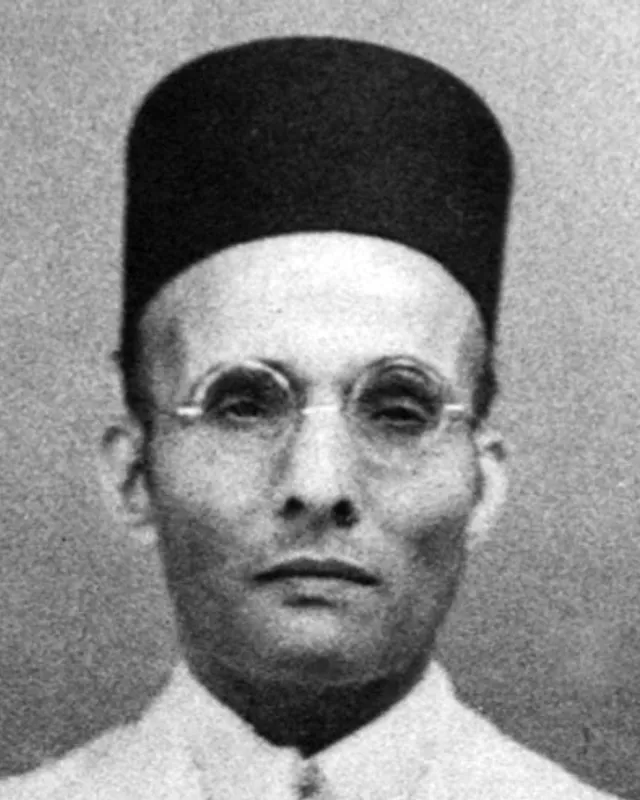
Portrait: Photograph, via Wikimedia Commons (opens in a new tab) · Public domain
V. D. Savarkar
- Country
- India
- Era
- 1883–1966
- Tradition
- Hindutva, Hindu nationalism
Revolutionary turned ideologue who coined Hindutva and defined the Indian nation by attachment to a common Hindu holy land — the founding text of the political tradition now dominant in India.
01
Documented positions
Documented positions come from the sources listed. Similarity is this project’s inference from those positions, and is a much weaker claim.
- Defined Hindutva as attachment to India as both fatherland and holy land, which excluded Muslims and Christians from full national belonging
- Argued that India was a nation of Hindus and endorsed a two-nation understanding of Hindus and Muslims as distinct peoples
- Called for the militarisation of Hindu society and encouraged Hindu recruitment into the British Indian Army during the Second World War
- Opposed Gandhi’s non-violence as a strategy and criticised his approach to Muslim political demands
- Was an atheist and rationalist who attacked caste untouchability, cow worship and religious orthodoxy as social practices
- Was tried in the assassination of Gandhi in 1948 and acquitted for lack of corroborating evidence
02
Where it sits on each dimension
Personal liberty
22
Collective orderIndividual freedom
Evidence: Documented
Tradition and change
45
ContinuityReform
Evidence: Documented
Nation and the world
98
InternationalistNationalist
Evidence: Well documented
Religion and the state
62
Secular stateReligion in public life
Evidence: Documented
Power and its limits
22
Concentrated authorityChecks and pluralism
Evidence: Documented
Dimensions left unscored, for want of evidence: Wealth and inequality, The state in the economy, Environment and growth, Crime and punishment
Sources
- V. D. Savarkar, Essentials of Hindutva · 1923
- Christophe Jaffrelot, The Hindu Nationalist Movement and Indian Politics · Columbia University Press · 1996
Last verified: