Thinkers and political figures
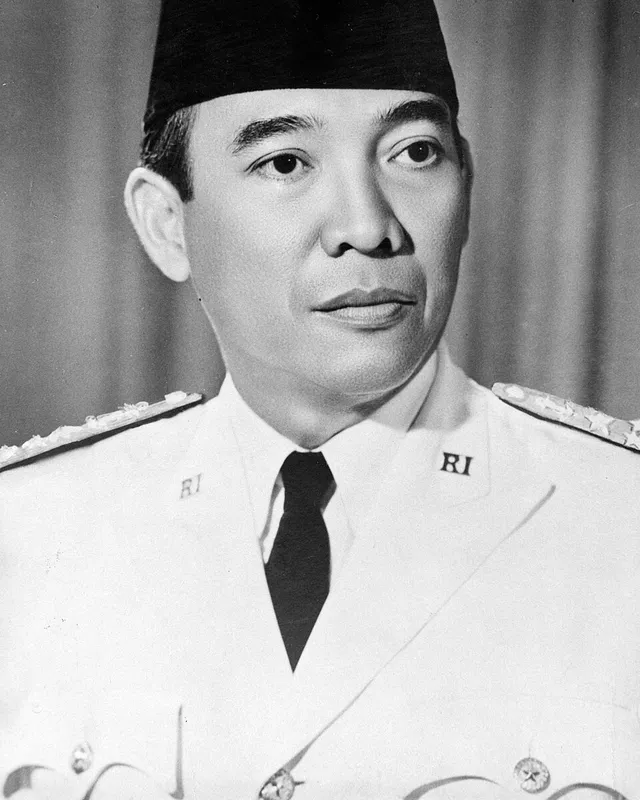
Portrait: Government of Indonesia, via Wikimedia Commons (opens in a new tab) · Public domain
Sukarno
- Country
- Indonesia
- Era
- 1901–1970
- Tradition
- Anti-colonial nationalism, guided democracy
Founding president of Indonesia, who held a vast archipelago together with the state ideology of Pancasila, convened the Bandung Conference that launched the non-aligned movement, and replaced parliament with "guided democracy".
Documented positions
Documented positions come from the sources listed. Similarity is this project’s inference from those positions, and is a much weaker claim.
- Formulated Pancasila — belief in God, humanitarianism, national unity, consultative democracy and social justice — as the state ideology
- Convened the 1955 Bandung Conference of Asian and African states, founding the non-aligned movement
- Replaced parliamentary government with "guided democracy" in 1959, concentrating power in the presidency
- Nationalised Dutch enterprises and pursued state-led industrialisation
- Attempted to balance the army, Islamic parties and the Communist Party against one another in a doctrine called Nasakom
- Withdrew Indonesia from the United Nations in 1965 in protest at Malaysia’s Security Council seat
- Pursued military confrontation with the new Malaysian federation
Where it sits on each dimension
Wealth and inequality
Evidence: Documented
The state in the economy
Evidence: Well documented
Personal liberty
Evidence: Documented
Tradition and change
Evidence: Documented
Nation and the world
Evidence: Well documented
Religion and the state
Evidence: Documented
Power and its limits
Evidence: Well documented
Dimensions left unscored, for want of evidence: Environment and growth, Crime and punishment
Sources
- Sukarno, The Birth of Pancasila · 1945
- John D. Legge, Sukarno: A Political Biography · Allen Lane · 1972
Last verified: