Thinkers and political figures
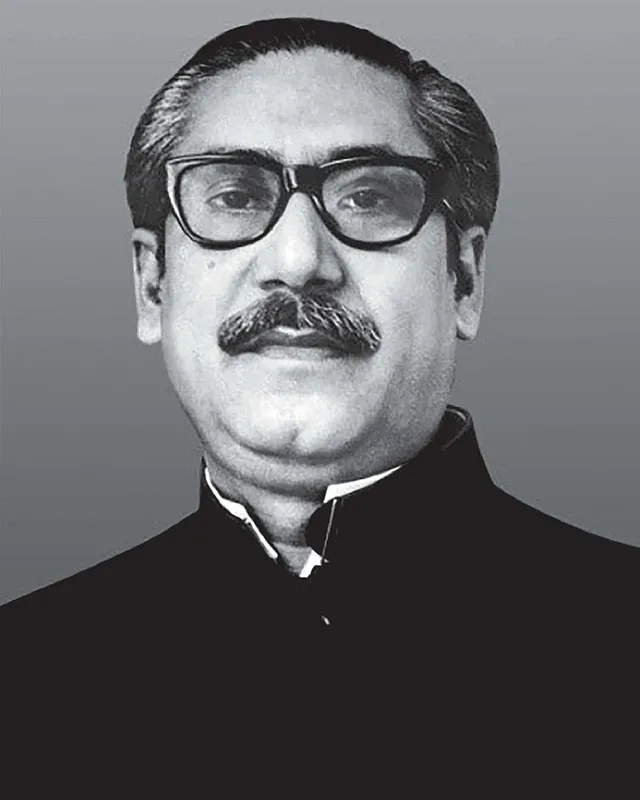
Portrait: Government of Bangladesh, via Wikimedia Commons (opens in a new tab) · Public domain
Sheikh Mujibur Rahman
- Country
- Bangladesh
- Era
- 1920–1975
- Tradition
- Bengali nationalism, secular socialism
Leader of the movement for Bengali autonomy that became the war of independence, founding president of Bangladesh, who consolidated power into a one-party state shortly before he and most of his family were killed in a coup.
Documented positions
Documented positions come from the sources listed. Similarity is this project’s inference from those positions, and is a much weaker claim.
- Set out the Six Point demand in 1966 for Bengali autonomy within Pakistan, covering federalism, taxation and separate currencies
- Won an outright majority in Pakistan’s 1970 election and was denied office, precipitating the 1971 war
- Founded Bangladesh on four stated principles: nationalism, secularism, socialism and democracy
- Nationalised banks, insurance and major industry after independence
- Established a one-party state under BAKSAL in January 1975 and banned all other parties and most newspapers
- Maintained close alignment with India and the Soviet Union in foreign policy
Where it sits on each dimension
Wealth and inequality
Evidence: Well documented
The state in the economy
Evidence: Well documented
Personal liberty
Evidence: Documented
Tradition and change
Evidence: Documented
Nation and the world
Evidence: Well documented
Religion and the state
Evidence: Well documented
Power and its limits
Evidence: Well documented
Dimensions left unscored, for want of evidence: Environment and growth, Crime and punishment
Sources
- Sheikh Mujibur Rahman, The Unfinished Memoirs · 2012
- Richard Sisson and Leo E. Rose, War and Secession: Pakistan, India, and the Creation of Bangladesh · University of California Press · 1990
Last verified: