Thinkers and political figures
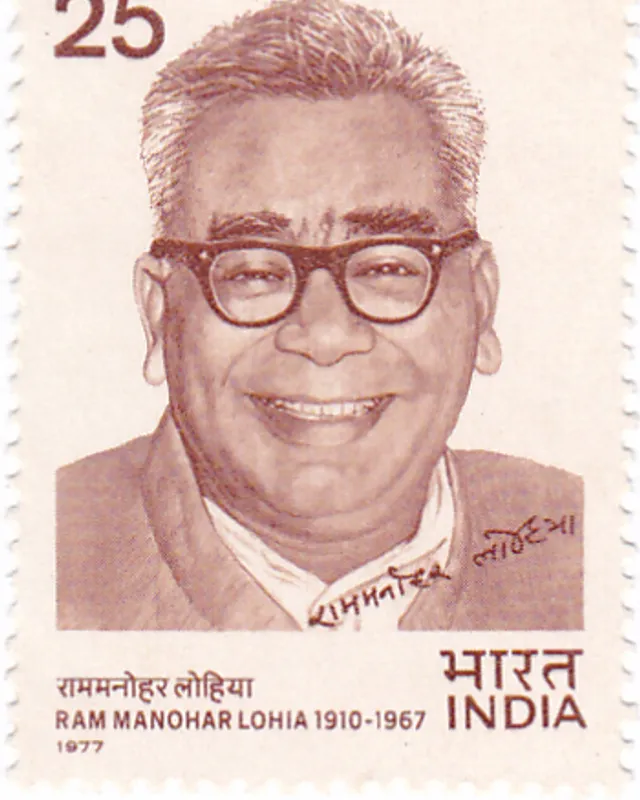
Portrait: India Post commemorative stamp, 1977, via Wikimedia Commons (opens in a new tab) · Government Open Data Licence – India
Ram Manohar Lohia
- Country
- India
- Era
- 1910–1967
- Tradition
- Democratic socialism, anti-caste politics
Socialist who argued that caste, not only class, was the central inequality in India, and whose insistence on reservations for backward castes shaped the parties that later broke Congress dominance in north India.
Documented positions
Documented positions come from the sources listed. Similarity is this project’s inference from those positions, and is a much weaker claim.
- Argued that caste and class inequality reinforce each other in India and must be attacked together
- Demanded that sixty per cent of government posts be reserved for backward castes, women and minorities
- Campaigned for the removal of English from administration in favour of Indian languages
- Advocated small-scale decentralised technology over large industrial projects
- Practised and theorised civil disobedience against the post-independence Congress governments
- Called for an income ceiling and sharp limits on the ratio between highest and lowest earnings
Where it sits on each dimension
Wealth and inequality
Evidence: Well documented
The state in the economy
Evidence: Documented
Personal liberty
Evidence: Documented
Tradition and change
Evidence: Well documented
Nation and the world
Evidence: Documented
Power and its limits
Evidence: Documented
Dimensions left unscored, for want of evidence: Religion and the state, Environment and growth, Crime and punishment
Sources
- Ram Manohar Lohia, The Caste System · 1964
- Ram Manohar Lohia, Wheel of History · 1955
Last verified: