Thinkers and political figures
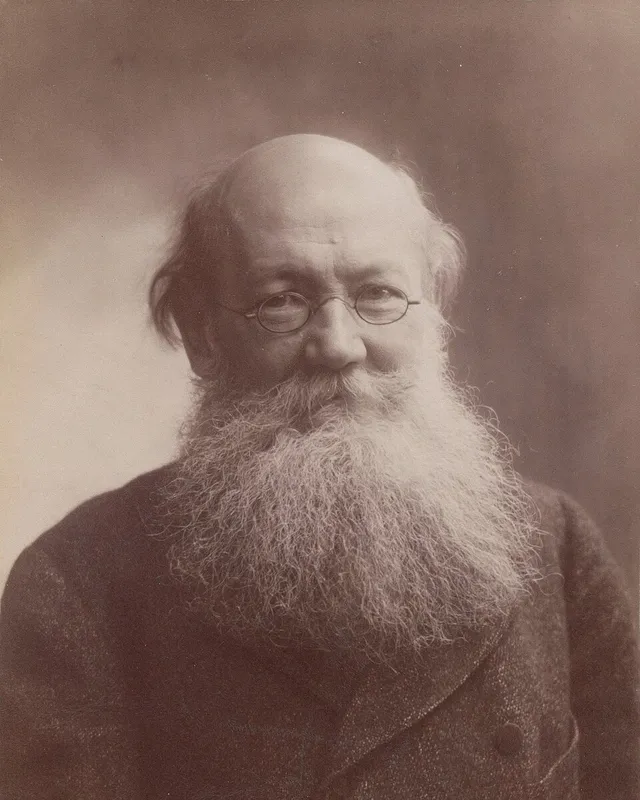
Portrait: Photograph, c. 1900, via Wikimedia Commons (opens in a new tab) · Public domain
Peter Kropotkin
- Country
- Russia
- Era
- 1842–1921
- Tradition
- Anarchist communism
Russian prince turned geographer and anarchist, who argued from biology that cooperation is at least as important as competition in evolution, and built a case for a society organised around voluntary mutual aid.
01
Documented positions
Documented positions come from the sources listed. Similarity is this project’s inference from those positions, and is a much weaker claim.
- Argued that mutual aid is a major factor in evolution, against the reading of Darwin as licensing pure competition
- Advocated abolition of both the state and private property, with distribution according to need
- Held that voluntary federations of communes could organise production without central direction
- Argued that integrating industry with agriculture and manual with intellectual work would make small-scale self-sufficiency viable
- Opposed wage labour even in a socialist form, rejecting payment by labour vouchers
- Condemned the Bolshevik seizure of power as the creation of a new bureaucratic tyranny
02
Where it sits on each dimension
Wealth and inequality
4
RedistributionMarket outcomes
Evidence: Well documented
The state in the economy
26
Active stateLimited state
Evidence: Documented
Personal liberty
92
Collective orderIndividual freedom
Evidence: Well documented
Tradition and change
86
ContinuityReform
Evidence: Well documented
Nation and the world
18
InternationalistNationalist
Evidence: Documented
Religion and the state
8
Secular stateReligion in public life
Evidence: Documented
Power and its limits
72
Concentrated authorityChecks and pluralism
Evidence: Documented
Crime and punishment
90
PunishmentRehabilitation
Evidence: Documented
Dimensions left unscored, for want of evidence: Environment and growth
Sources
- Peter Kropotkin, Mutual Aid: A Factor of Evolution · 1902
- Peter Kropotkin, The Conquest of Bread · 1892
Last verified: