Thinkers and political figures
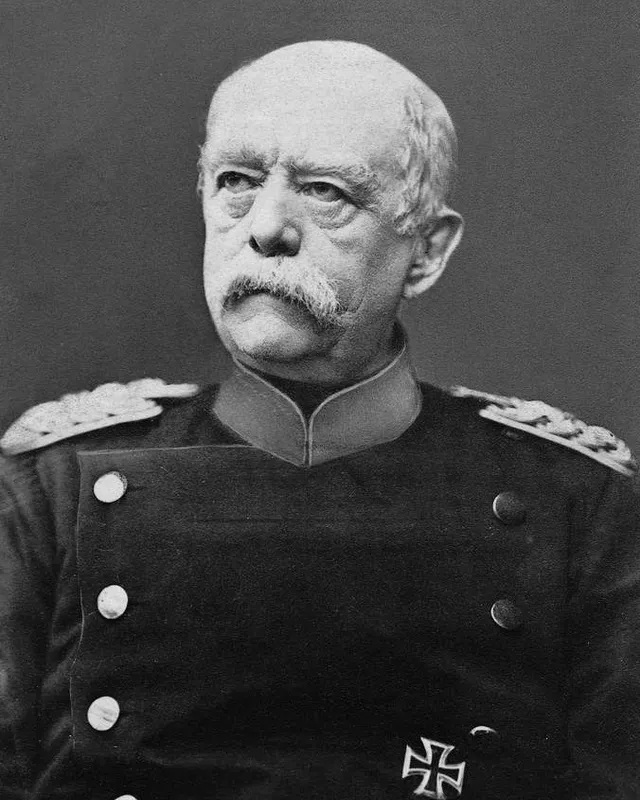
Portrait: Photograph, 1885, via Wikimedia Commons (opens in a new tab) · Public domain
Otto von Bismarck
- Country
- Prussia and Germany
- Era
- 1815–1898
- Tradition
- Conservative nationalism, state paternalism
Prussian minister who unified Germany through three engineered wars and then invented the modern welfare state — old-age pensions, health and accident insurance — explicitly to cut the ground from under the socialists.
Documented positions
Documented positions come from the sources listed. Similarity is this project’s inference from those positions, and is a much weaker claim.
- Unified Germany under Prussian leadership through wars with Denmark, Austria and France between 1864 and 1871
- Created the world’s first national health insurance, accident insurance and old-age pension systems in the 1880s
- Stated openly that social insurance was intended to reconcile workers to the state and undercut socialism
- Banned the Social Democratic Party’s organisation and press under the Anti-Socialist Laws
- Waged the Kulturkampf against the political influence of the Catholic Church, then abandoned it
- Maintained universal male suffrage for the Reichstag while keeping the chancellor answerable to the emperor alone
- Built a system of alliances designed to keep France isolated and avoid a war on two fronts
Where it sits on each dimension
Wealth and inequality
Evidence: Well documented
The state in the economy
Evidence: Well documented
Personal liberty
Evidence: Well documented
Tradition and change
Evidence: Well documented
Nation and the world
Evidence: Well documented
Religion and the state
Evidence: Well documented
Power and its limits
Evidence: Well documented
Dimensions left unscored, for want of evidence: Environment and growth, Crime and punishment
Sources
- Otto von Bismarck, Thoughts and Recollections · 1898
- Jonathan Steinberg, Bismarck: A Life · Oxford University Press · 2011
Last verified: