Thinkers and political figures
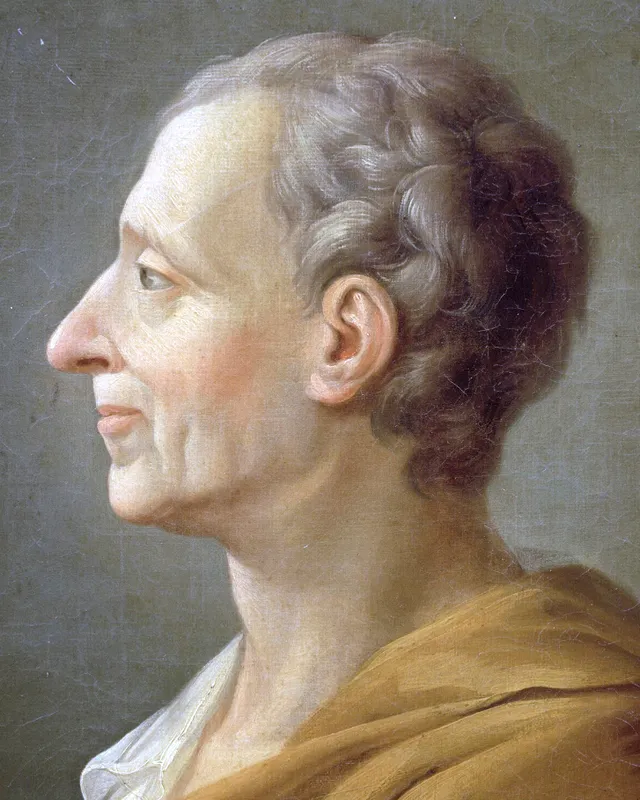
Portrait: Anonymous, via Wikimedia Commons (opens in a new tab) · Public domain
Montesquieu
- Country
- France
- Era
- 1689–1755
- Tradition
- Constitutional liberalism
French judge and philosopher whose account of the separation of powers shaped the constitutions of the United States and, through them, much of the world.
01
Documented positions
Documented positions come from the sources listed. Similarity is this project’s inference from those positions, and is a much weaker claim.
- Argued that liberty requires legislative, executive and judicial power to be held by different hands
- Held that laws should be adapted to the climate, customs and circumstances of each people rather than imposed uniformly
- Criticised despotism as government by fear, and distinguished it from monarchy governed by fixed laws
- Opposed slavery in The Spirit of the Laws, treating the standard justifications for it as self-evidently absurd
- Favoured intermediate bodies — nobility, courts, towns — as brakes on the central power of the crown
02
Where it sits on each dimension
Personal liberty
74
Collective orderIndividual freedom
Evidence: Well documented
Tradition and change
46
ContinuityReform
Evidence: Documented
Nation and the world
44
InternationalistNationalist
Evidence: Documented
Religion and the state
40
Secular stateReligion in public life
Evidence: Documented
Power and its limits
88
Concentrated authorityChecks and pluralism
Evidence: Well documented
Crime and punishment
62
PunishmentRehabilitation
Evidence: Documented
Dimensions left unscored, for want of evidence: Wealth and inequality, The state in the economy, Environment and growth
Sources
- Montesquieu, The Spirit of the Laws · 1748
- Judith N. Shklar, Montesquieu · Oxford University Press · 1987
Last verified: