Thinkers and political figures
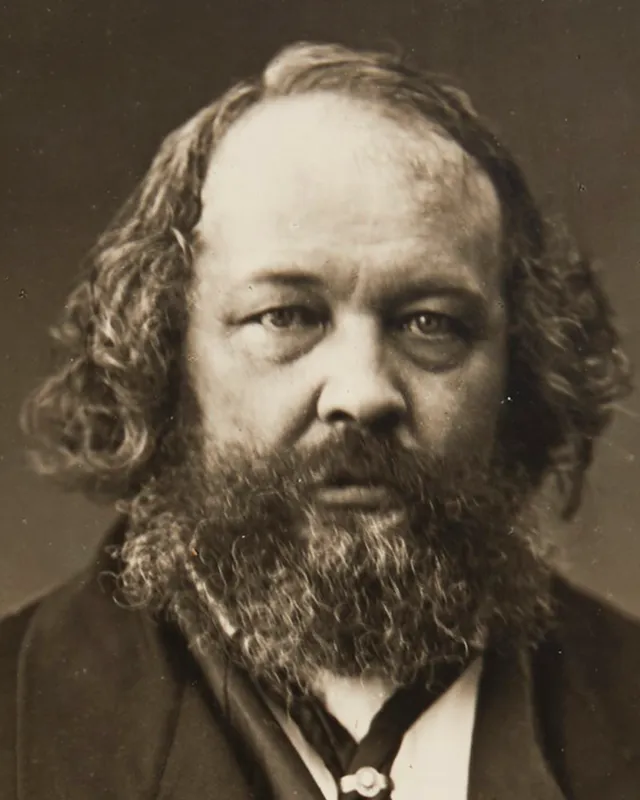
Portrait: Nadar, via Wikimedia Commons (opens in a new tab) · Public domain
Mikhail Bakunin
- Country
- Russia
- Era
- 1814–1876
- Tradition
- Collectivist anarchism
Russian revolutionary who split the First International with Marx by predicting that a workers’ state would produce a new ruling class of former workers rather than dissolve itself.
01
Documented positions
Documented positions come from the sources listed. Similarity is this project’s inference from those positions, and is a much weaker claim.
- Argued that the state must be abolished outright rather than captured and used by the working class
- Predicted that a "dictatorship of the proletariat" would become a despotism run by ex-workers turned officials
- Advocated federation of freely associating communes and workers’ associations from the bottom up
- Held that liberty without equality is privilege and equality without liberty is slavery
- Rejected religion, arguing that belief in divine authority underwrites obedience to earthly authority
- Favoured collective ownership of the means of production with distribution according to labour contributed
02
Where it sits on each dimension
Wealth and inequality
6
RedistributionMarket outcomes
Evidence: Well documented
The state in the economy
30
Active stateLimited state
Evidence: Documented
Personal liberty
92
Collective orderIndividual freedom
Evidence: Well documented
Tradition and change
88
ContinuityReform
Evidence: Well documented
Nation and the world
22
InternationalistNationalist
Evidence: Documented
Religion and the state
2
Secular stateReligion in public life
Evidence: Well documented
Power and its limits
70
Concentrated authorityChecks and pluralism
Evidence: Documented
Dimensions left unscored, for want of evidence: Environment and growth, Crime and punishment
Sources
- Mikhail Bakunin, Statism and Anarchy · 1873
- Mikhail Bakunin, God and the State · 1882
Last verified: