Thinkers and political figures
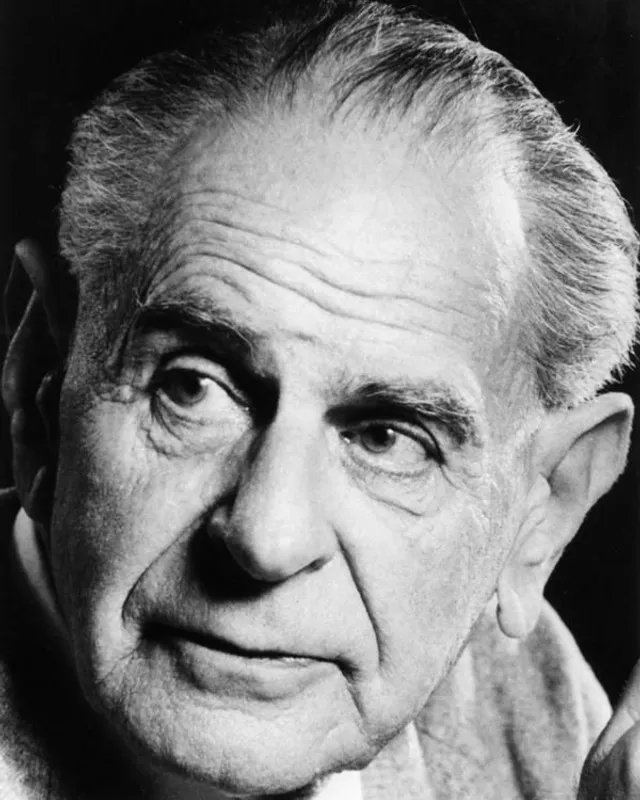
Portrait: LSE Library, via Wikimedia Commons (opens in a new tab) · No known copyright restrictions
Karl Popper
- Country
- Austria and the United Kingdom
- Era
- 1902–1994
- Tradition
- Open society liberalism
Philosopher of science who turned his account of knowledge into a political argument: because we cannot know what is best, we need institutions that let us remove governments and correct mistakes without violence.
01
Documented positions
Documented positions come from the sources listed. Similarity is this project’s inference from those positions, and is a much weaker claim.
- Argued that the test of a democracy is whether a government can be removed without bloodshed, not whether the majority rules
- Rejected large-scale utopian planning in favour of "piecemeal social engineering" that can be corrected when it fails
- Held that Plato, Hegel and Marx supplied the intellectual foundations of twentieth-century totalitarianism
- Defended a substantial welfare state and state intervention to protect the weak from the economically strong
- Formulated the paradox of tolerance: unlimited tolerance of the intolerant destroys tolerance itself
- Held that no theory can be verified, only falsified, and applied the same fallibilism to political programmes
02
Where it sits on each dimension
Wealth and inequality
45
RedistributionMarket outcomes
Evidence: Documented
The state in the economy
55
Active stateLimited state
Evidence: Documented
Personal liberty
78
Collective orderIndividual freedom
Evidence: Well documented
Tradition and change
62
ContinuityReform
Evidence: Documented
Nation and the world
22
InternationalistNationalist
Evidence: Documented
Power and its limits
92
Concentrated authorityChecks and pluralism
Evidence: Well documented
Dimensions left unscored, for want of evidence: Religion and the state, Environment and growth, Crime and punishment
Sources
- Karl Popper, The Open Society and Its Enemies · 1945
- Karl Popper, The Poverty of Historicism · 1957
Last verified: