Thinkers and political figures
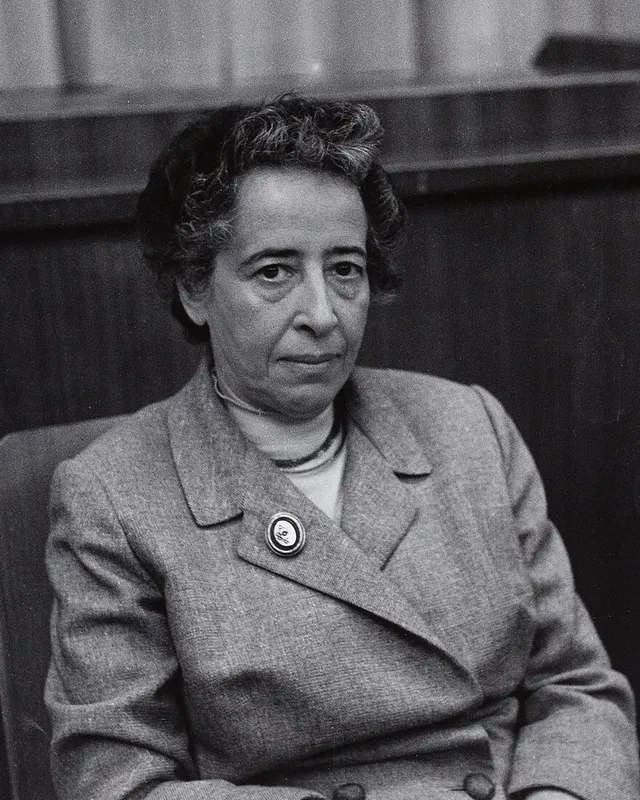
Portrait: Barbara Niggl Radloff, via Wikimedia Commons (opens in a new tab) · Creative Commons Attribution-ShareAlike 4.0
Hannah Arendt
- Country
- Germany and the United States
- Era
- 1906–1975
- Tradition
- Republicanism, political theory
Analysed how totalitarian movements destroy the space in which politics happens, and argued that the worst crimes are often committed by unremarkable people who have stopped thinking.
01
Documented positions
Documented positions come from the sources listed. Similarity is this project’s inference from those positions, and is a much weaker claim.
- Totalitarianism is a novel form of rule that destroys plurality and private life (The Origins of Totalitarianism, 1951)
- Politics is action among equals in public, not administration of things (The Human Condition, 1958)
- "The banality of evil": atrocity carried out by ordinary functionaries who refuse to think
- Statelessness strips people of "the right to have rights"
- Defended council democracy and constitutional founding over mass party politics
02
Where it sits on each dimension
Personal liberty
84
Collective orderIndividual freedom
Evidence: Well documented
Tradition and change
62
ContinuityReform
Evidence: Documented
Nation and the world
30
InternationalistNationalist
Evidence: Well documented
Power and its limits
90
Concentrated authorityChecks and pluralism
Evidence: Well documented
Dimensions left unscored, for want of evidence: Wealth and inequality, The state in the economy, Environment and growth, Crime and punishment, Religion and the state
Sources
- Hannah Arendt, The Origins of Totalitarianism · 1951
- Hannah Arendt, The Human Condition · 1958
- Hannah Arendt, Eichmann in Jerusalem · 1963
Last verified: