Thinkers and political figures
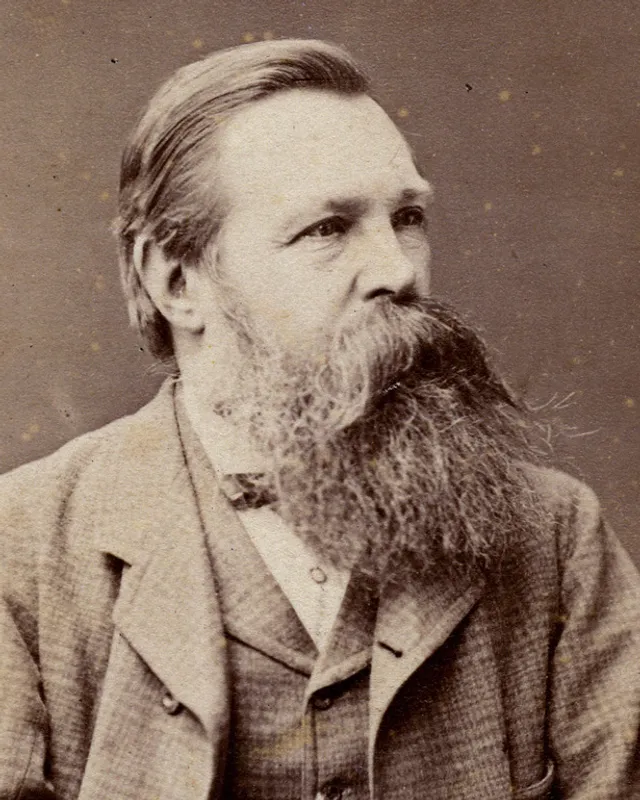
Portrait: Via Wikimedia Commons (opens in a new tab) · Public domain
Friedrich Engels
- Country
- Prussia, later England
- Era
- 1820–1895
- Tradition
- Communism
Documented industrial poverty in Manchester in detail, co-wrote the Communist Manifesto, and argued that the subordination of women had material and historical rather than natural causes.
01
Documented positions
Documented positions come from the sources listed. Similarity is this project’s inference from those positions, and is a much weaker claim.
- Empirical documentation of working-class conditions in industrial England (1845)
- Co-authored the Communist Manifesto with Marx
- Argued the family and women’s subordination arose from property relations, not nature
- Held that the state would eventually "wither away" rather than be permanently expanded
02
Where it sits on each dimension
Wealth and inequality
4
RedistributionMarket outcomes
Evidence: Well documented
The state in the economy
12
Active stateLimited state
Evidence: Documented
Tradition and change
86
ContinuityReform
Evidence: Well documented
Nation and the world
12
InternationalistNationalist
Evidence: Documented
Religion and the state
6
Secular stateReligion in public life
Evidence: Well documented
Dimensions left unscored, for want of evidence: Environment and growth, Crime and punishment, Power and its limits, Personal liberty
Sources
- Friedrich Engels, The Condition of the Working Class in England · 1845
- Friedrich Engels, The Origin of the Family, Private Property and the State · 1884
Last verified: