Thinkers and political figures
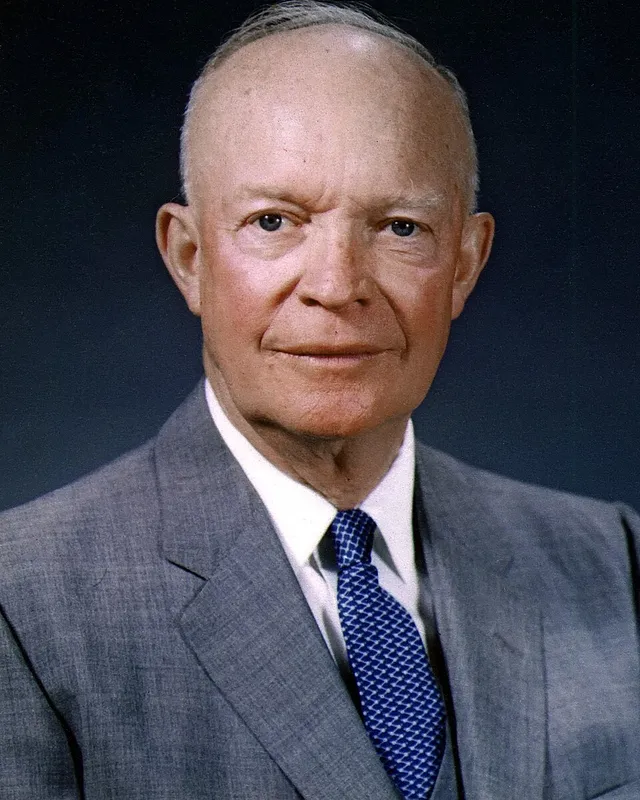
Portrait: White House photograph, 1959, via Wikimedia Commons (opens in a new tab) · Public domain
Dwight D. Eisenhower
- Country
- United States
- Era
- 1890–1969
- Tradition
- Modern Republicanism
Supreme Allied Commander turned president, who accepted the New Deal rather than reversing it, built the interstate highway system, and left office warning against the military-industrial complex he had helped create.
01
Documented positions
Documented positions come from the sources listed. Similarity is this project’s inference from those positions, and is a much weaker claim.
- Accepted and extended New Deal programmes, expanding Social Security coverage and raising the minimum wage
- Built the Interstate Highway System as the largest public works programme in American history
- Sent federal troops to Little Rock to enforce school desegregation against the state governor
- Warned in his farewell address against the "unwarranted influence" of the military-industrial complex
- Authorised covert CIA operations that overthrew elected governments in Iran in 1953 and Guatemala in 1954
- Ended the Korean War and resisted pressure for direct intervention in Vietnam and at Suez
02
Where it sits on each dimension
Wealth and inequality
52
RedistributionMarket outcomes
Evidence: Well documented
The state in the economy
48
Active stateLimited state
Evidence: Well documented
Personal liberty
48
Collective orderIndividual freedom
Evidence: Documented
Tradition and change
48
ContinuityReform
Evidence: Documented
Nation and the world
52
InternationalistNationalist
Evidence: Well documented
Religion and the state
62
Secular stateReligion in public life
Evidence: Documented
Power and its limits
66
Concentrated authorityChecks and pluralism
Evidence: Documented
Dimensions left unscored, for want of evidence: Environment and growth, Crime and punishment
Sources
- Dwight D. Eisenhower, Farewell Address to the Nation · 1961
- William I. Hitchcock, The Age of Eisenhower · Simon & Schuster · 2018
Last verified: