Thinkers and political figures
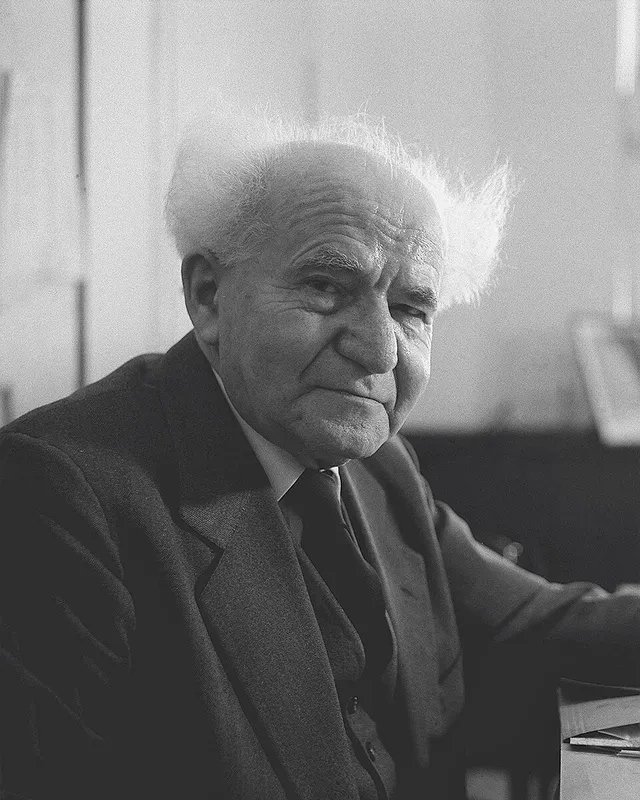
Portrait: Government Press Office of Israel, via Wikimedia Commons (opens in a new tab) · Public domain
David Ben-Gurion
- Country
- Israel
- Era
- 1886–1973
- Tradition
- Labour Zionism
Israel’s founding prime minister, who declared the state in 1948, built its army and institutions on socialist lines, and set the terms of its relationship with religion and with the Palestinians who were displaced.
Documented positions
Documented positions come from the sources listed. Similarity is this project’s inference from those positions, and is a much weaker claim.
- Declared the establishment of Israel in May 1948 and led it through the war that followed
- Built a state economy around the Histadrut labour federation, cooperative agriculture and public ownership
- Dissolved independent armed militias into a single national army under civilian control
- Agreed the "status quo" arrangement giving religious authorities control over marriage, burial and the Sabbath in public life
- Accepted the UN partition plan while stating that its borders were not final
- Presided over the period in which around 700,000 Palestinians were displaced and their return was barred
- Negotiated the reparations agreement with West Germany against fierce domestic opposition
Where it sits on each dimension
Wealth and inequality
Evidence: Well documented
The state in the economy
Evidence: Well documented
Personal liberty
Evidence: Documented
Tradition and change
Evidence: Documented
Nation and the world
Evidence: Well documented
Religion and the state
Evidence: Well documented
Power and its limits
Evidence: Documented
Dimensions left unscored, for want of evidence: Environment and growth, Crime and punishment
Sources
- David Ben-Gurion, Israel: A Personal History · 1971
- Tom Segev, A State at Any Cost: The Life of David Ben-Gurion · Farrar, Straus and Giroux · 2019
Last verified: