Thinkers and political figures
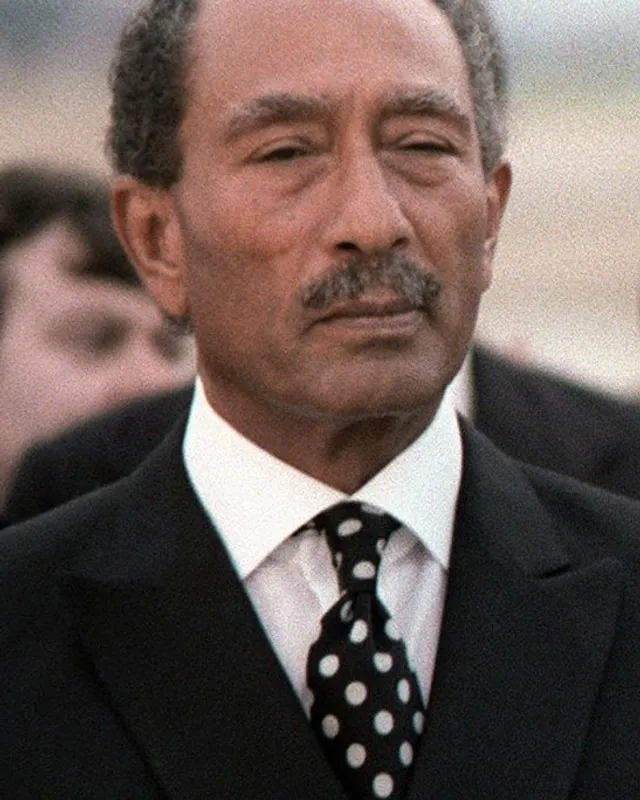
Portrait: Photograph, via Wikimedia Commons (opens in a new tab) · Public domain
Anwar Sadat
- Country
- Egypt
- Era
- 1918–1981
- Tradition
- Economic liberalisation, pragmatic nationalism
Nasser’s successor, who reversed almost every element of his predecessor’s policy — expelling Soviet advisers, opening the economy, and making peace with Israel, for which he was assassinated by Islamist officers.
01
Documented positions
Documented positions come from the sources listed. Similarity is this project’s inference from those positions, and is a much weaker claim.
- Launched the 1973 war to break the diplomatic deadlock over the Sinai, then pivoted to negotiation
- Signed the Camp David Accords and the 1979 peace treaty with Israel, the first by any Arab state
- Expelled Soviet military advisers in 1972 and realigned Egypt with the United States
- Introduced the infitah open-door policy, liberalising trade and encouraging foreign investment
- Released imprisoned Muslim Brotherhood members and used Islamist groups against the left, then turned on them
- Attempted to cut bread subsidies in 1977, provoking riots that forced their restoration
- Arrested more than a thousand opposition figures across the political spectrum a month before his assassination
02
Where it sits on each dimension
Wealth and inequality
68
RedistributionMarket outcomes
Evidence: Well documented
The state in the economy
66
Active stateLimited state
Evidence: Well documented
Personal liberty
25
Collective orderIndividual freedom
Evidence: Documented
Tradition and change
40
ContinuityReform
Evidence: Documented
Nation and the world
70
InternationalistNationalist
Evidence: Well documented
Religion and the state
60
Secular stateReligion in public life
Evidence: Documented
Power and its limits
22
Concentrated authorityChecks and pluralism
Evidence: Well documented
Dimensions left unscored, for want of evidence: Environment and growth, Crime and punishment
Sources
- Anwar Sadat, In Search of Identity: An Autobiography · 1978
- Egypt, Israel and the United States, The Camp David Accords · 1978
Last verified: