
 , Return capture at checkout
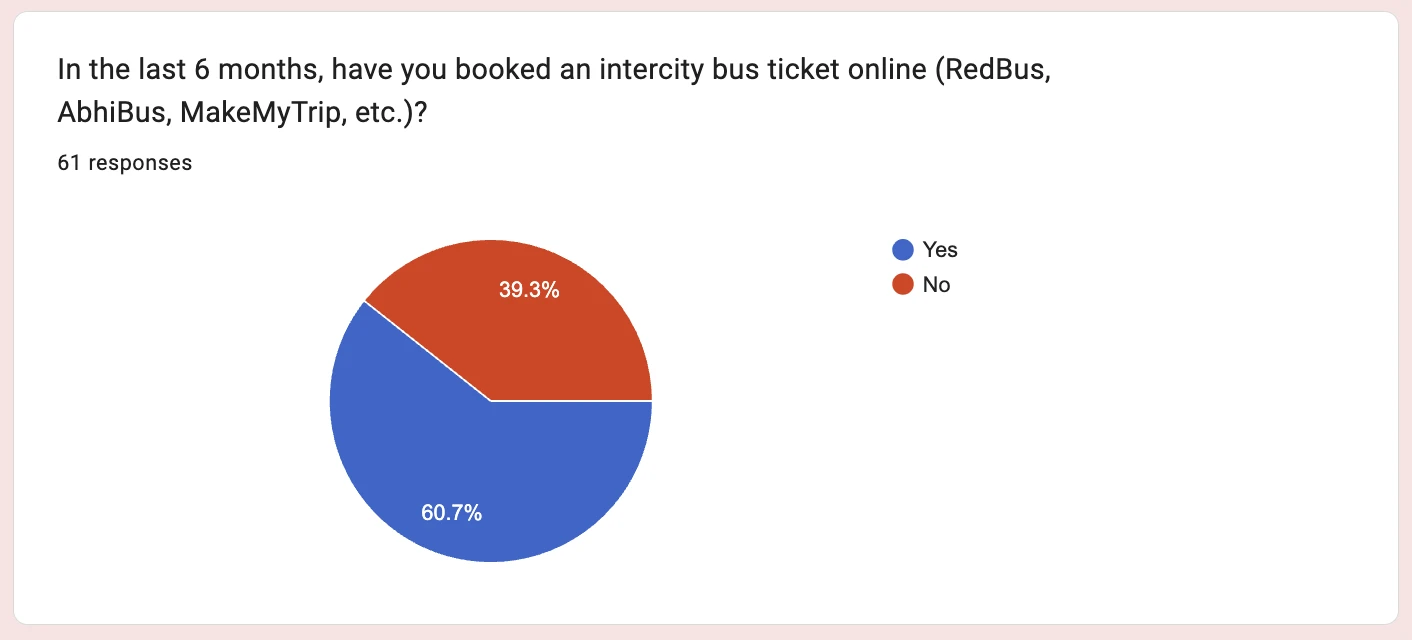
Every artefact from the provisional bet through to the design brief, in the order it was made. 8 interviews · 102 atomic notes · 6 clusters · survey n=23 qualified from 61.
How RedBus makes money, and the number that proves value was delivered. This sets the AARRR stage and the provisional metric on the scope card that follows.
Transaction marketplace
A commission on every ticket, paid by the operator, reported at roughly 10–20%, and the large majority of revenue. A second line, the seat-inventory software sold to operators, is untouched by this work. Owned by MakeMyTrip. Figures are publicly reported, not verified here.
Win the whole journey, not half of it
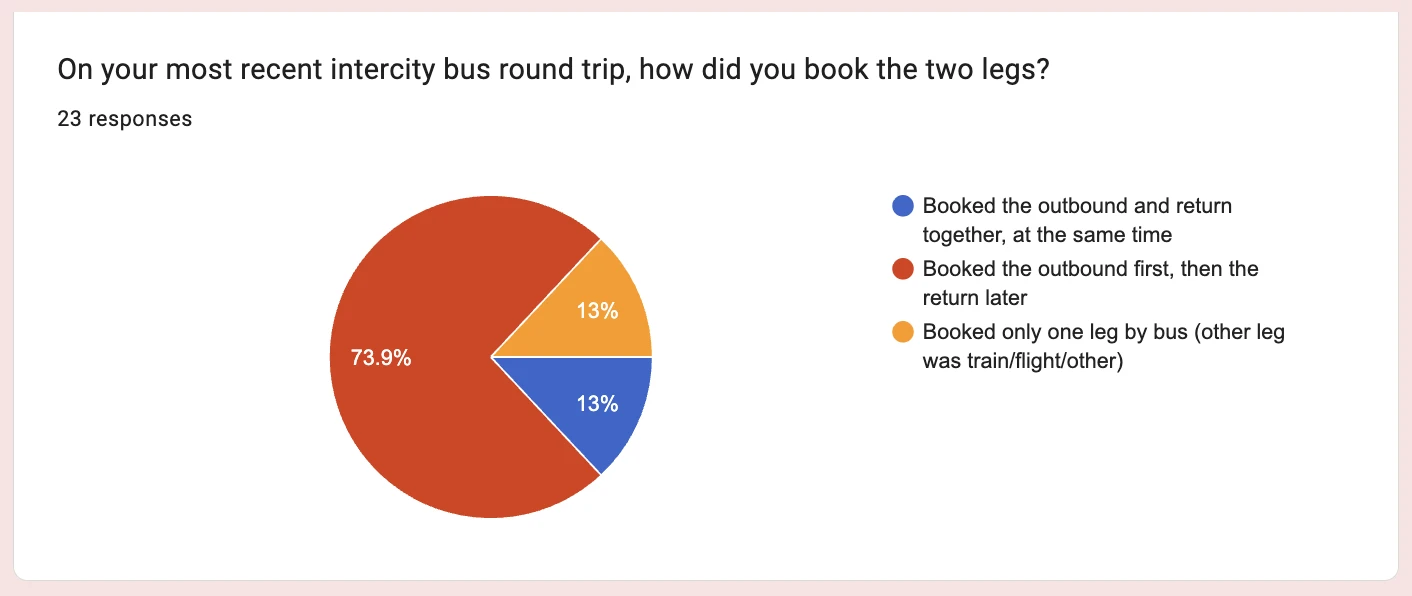
A round trip closed in one session is two commissions at one acquisition cost. The second leg is already intended: 73.9% booked the outbound first and the return later, and 26.1% booked a return on another app.
Frequency and trust
A transaction model rewards fast, frictionless and confidence-building. It punishes anything that slows the outbound, which is why the return step is skippable, never modal, and sits behind a guardrail rather than a target.
Journeys booked on RedBus per active traveller per year
Captures share of an existing journey. Does not create demand.
The bet, placed before any user contact.
“I’m designing the return-capture decision at checkout for young professionals who frequently take intercity round trips by bus, targeting Revenue, to lift in-session return-attach rate, because I currently believe travellers postpone booking their return due to commitment risk rather than lack of intent.”
What was planned, and what actually came back.
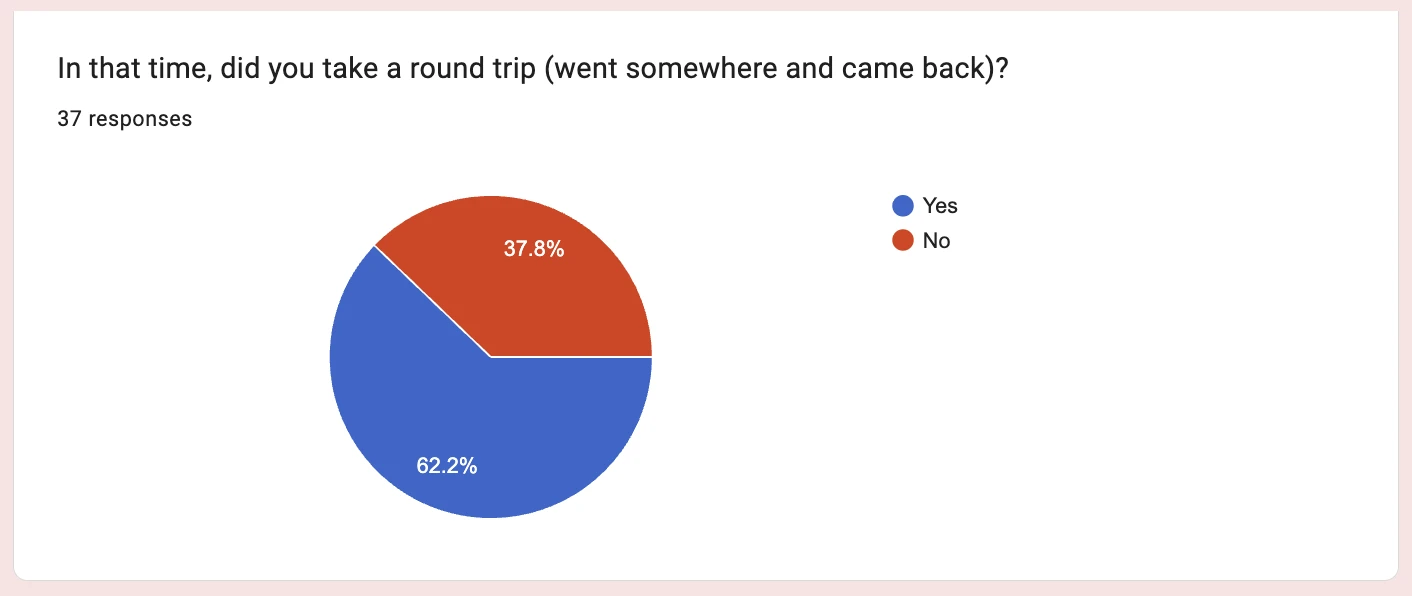
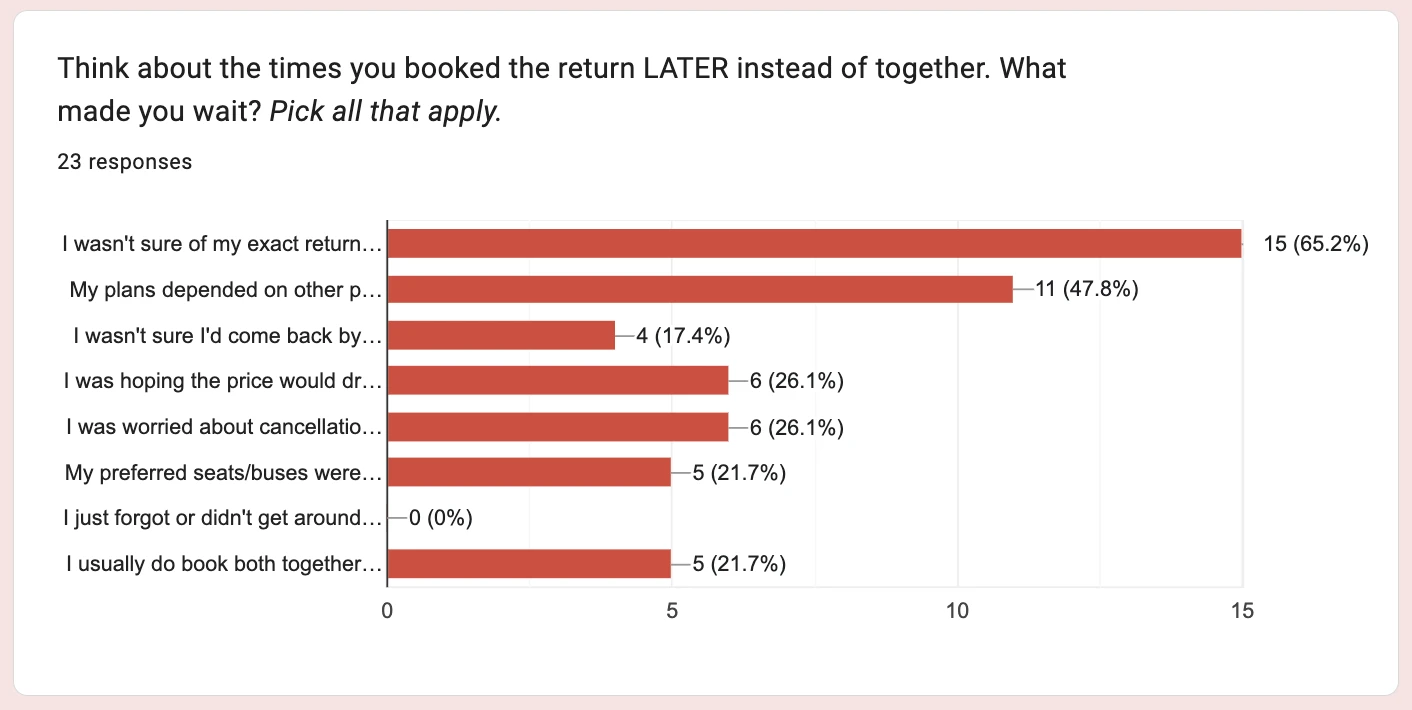
The survey, straight from the Google Forms responses page. Q1 and Q2 filter to the 23 who took a round trip by bus; Q3 to Q8 are out of those 23.
102 notes from 8 interviews and the survey. One observation per note. Nothing deleted.
“I never do round trip kind of bookings”, books the second ticket late, every time
Booked the return the day before; ₹300 vs ₹700 outbound. Price-drop hack learned from a stranger on a trip
Booked the outbound immediately to lock friends in, “just to get that confirmation... so no one cancels on the last time”
“date of return was not that confirmed... maybe I don't want to come on the next day maybe I want to spend two more days there”
“Flexibility is very important”
Asked if he wishes he'd booked together: “No, I wish the opposite of this”
On change/cancel: “I know there is an option but I just prefer okay this option doesn't exist”
Booked both together once, friend flew in for Ooty, three fixed days, hotels and rentals depended on it
Wants a Skyscanner-style price calendar: “I'll do that as soon as possible so that I just lock in”
“mostly whenever I plan travel the coming back I don't fix it. It's impromptu only”
Has never used the round-trip option, “I think you are referring to that round trip option, I never used it”
Skips the cancellation add-on solo (₹1500–2000, partial refund anyway); would buy it for a group
A ₹10,000 flight cancellation loss changed his mind about add-ons when the amount is big
Books a bus ticket as a hedge while a train waitlist resolves, cancels whichever loses
Outbound booked immediately, Diwali, “all the seats are getting booked really quickly”
Return not booked, “how much days I am going to stay there wasn't fixed at that point”
A ₹50–100 discount pop-up is what actually triggered the return booking: “that pop-up is what led me”
Would book both together to secure the seat, “a piece of mind that I have secured my seat for that date”
Asked if he'd still do it without the discount: “then also for me that piece of mind is really important”
Prefers buses with flexi-ticket / refund options; has used them three or four times
Cancelled for a family emergency, took a partial refund, rebooked the same bus days later
For long planned vacations, both legs and hotels booked upfront, “planned to the point”
“Book one and the other later”
Return depended on recovering from a broken leg and on a friend leaving the city
Booked the return a day before travel
Off-season return, prices low, preferred seat available, nothing changed
Didn't know FlexiTicket existed
“if I am going for a trip I know if it is a weekend trip I'll do both of them together. But if I am traveling to my home town I don't”
Alone with a fixed date she'd book together, “my second thought would be if the seats are not available then what”
On booking both together: “I did feel like halka” (lighter)
Group trips depend on whether the other person will lock in, or wants to wait for a price drop
Wrong-date booking on AbhiBus, ₹5k, 50% back, wants a Zepto-style five-minute edit window
Waited a week, long-weekend prices high and preferred seat unavailable
Return deferred, unsure whether he'd stay for a wedding
Checked return buses while booking the outbound, got no hits, “I didn't pay much attention”
Return ended up cheaper (₹1700 vs ₹1900) because demand was low
Bought the cancellation add-on and travel insurance on the return, precisely because he was unsure
Believes prices only rise with time, so never waits deliberately
Udupi round trip booked together, “I was much calmer and I didn't at all think about the return journey”
Festival trip, “I was always keep on thinking whether I'm gonna stay longer... how the prices are... I don't want to keep anything unknown”
Booked both legs together, event with a defined end and Monday office
Single location → round trip together. Multiple locations → never
“Not because of prices but because of clarity over plan”
Fears repeated price-checking pushes prices up, so avoids checking; screenshots and shares with a friend instead
Skips the cancellation add-on when the plan is fixed, “jab sab kuch fixed hi hai toh bhai tumko 300 rupe kaye ko dene ka”
Would buy it when travelling with parents, “300 rupees as a good ROI for me”
Tyre burst en route to Chikmagalur, missed the bus, no option to reschedule
Has never booked both legs together
Booked early once, wanted to push the date, couldn't, “we regretted it”. After that, always 1–2 days before
Group, “till the last day it was not final who wants to leave and who wants to stay”
Booking late meant high prices and no seat of choice; motion sick, ends up at the back
Not enough seats left, the group had to split across two or three buses
Personally always argued to book together; the group overruled her
Learned by observation that prices don't drop, “it was mostly stable only, or increased”
Local buses as an always-available backup made deferring feel safe
Exam trip, wanted to change, no refund, abandoned the ticket and booked another
Cancellation window “hidden somewhere down there”, not visible while booking
Books the round trip when leave is already approved, “sometimes cheaper for me”
Family wedding, dates not final, depended on whether he could work from the village → outbound only
The return then cost ₹1300–1400 instead of the usual ₹1000
Peak season, return seats simply unavailable; had to wait for a cancellation or an extra bus
Cancellation charge scales 20% / 40% / 80% as the date nears, “so I usually avoid those”
Selects a seat, leaves to confirm with parents, comes back, seat gone
Prefers losing the seat at checkout over booking and paying a cancellation charge if his parents disagree
Uninstalls the app between trips; a marketing push brings him back
73.9% booked the outbound first and the return later. Only 13% booked together
65.2% “I wasn't sure of my exact return date”
47.8% “My plans depended on other people”
26.1% “I was hoping the price would drop”
26.1% “I was worried about cancellation”
21.7% “My preferred seats/buses were…”
0% “I just forgot or didn't get around to it”
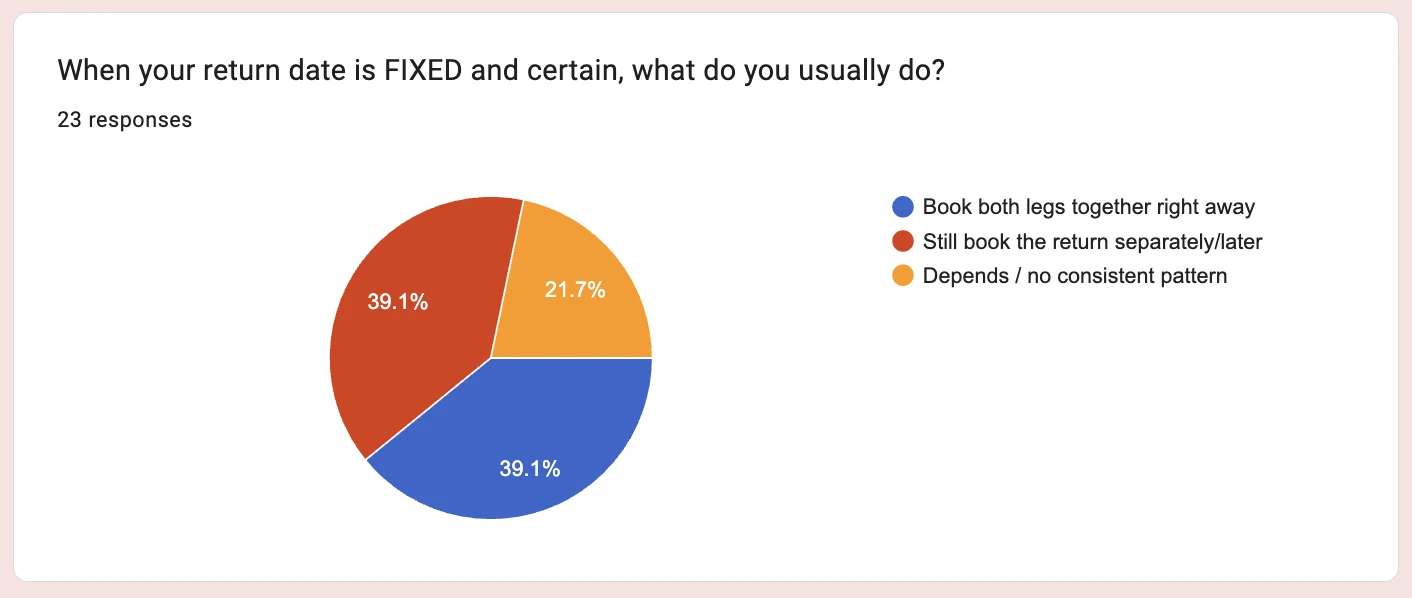
When the return date is FIXED, 39.1% still book the return separately (39.1% book together, 21.7% depends)
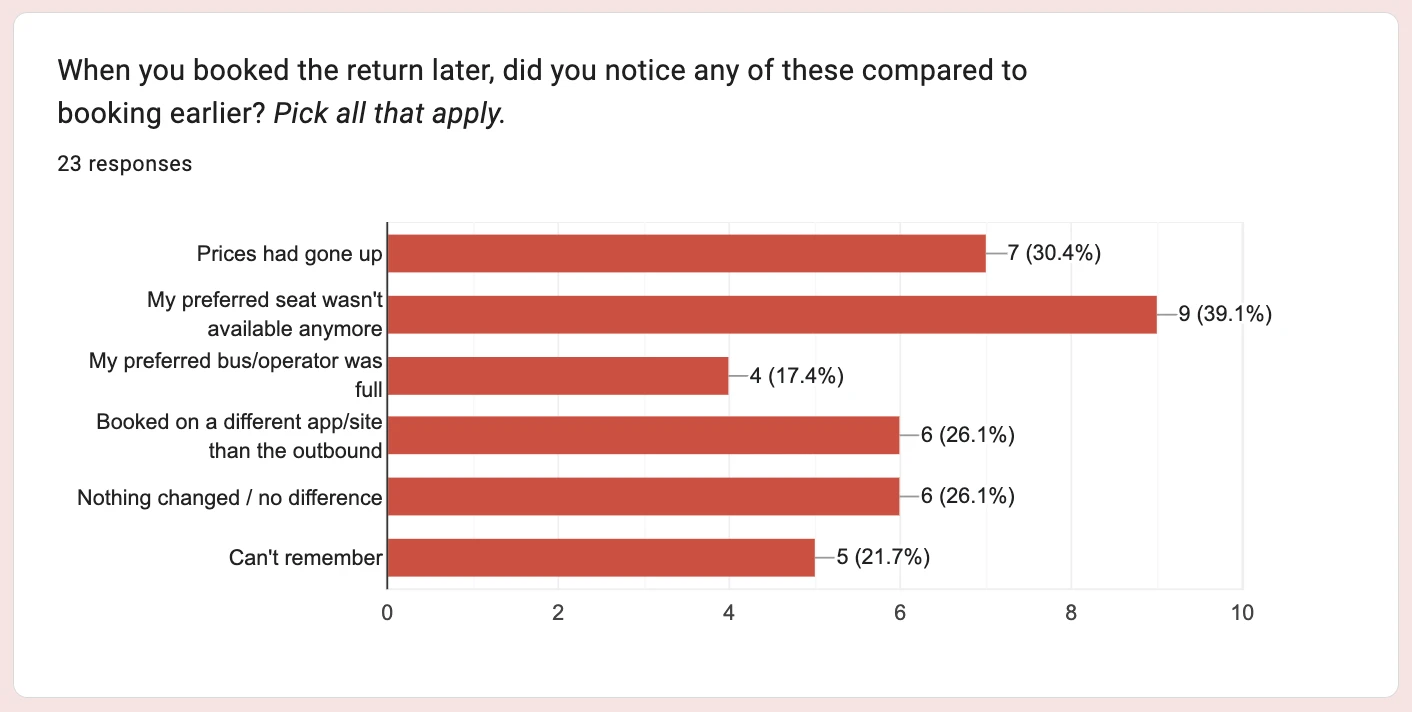
Booking later: 39.1% found their preferred seat gone; 30.4% found prices had gone up
26.1% booked the return on a different app than the outbound
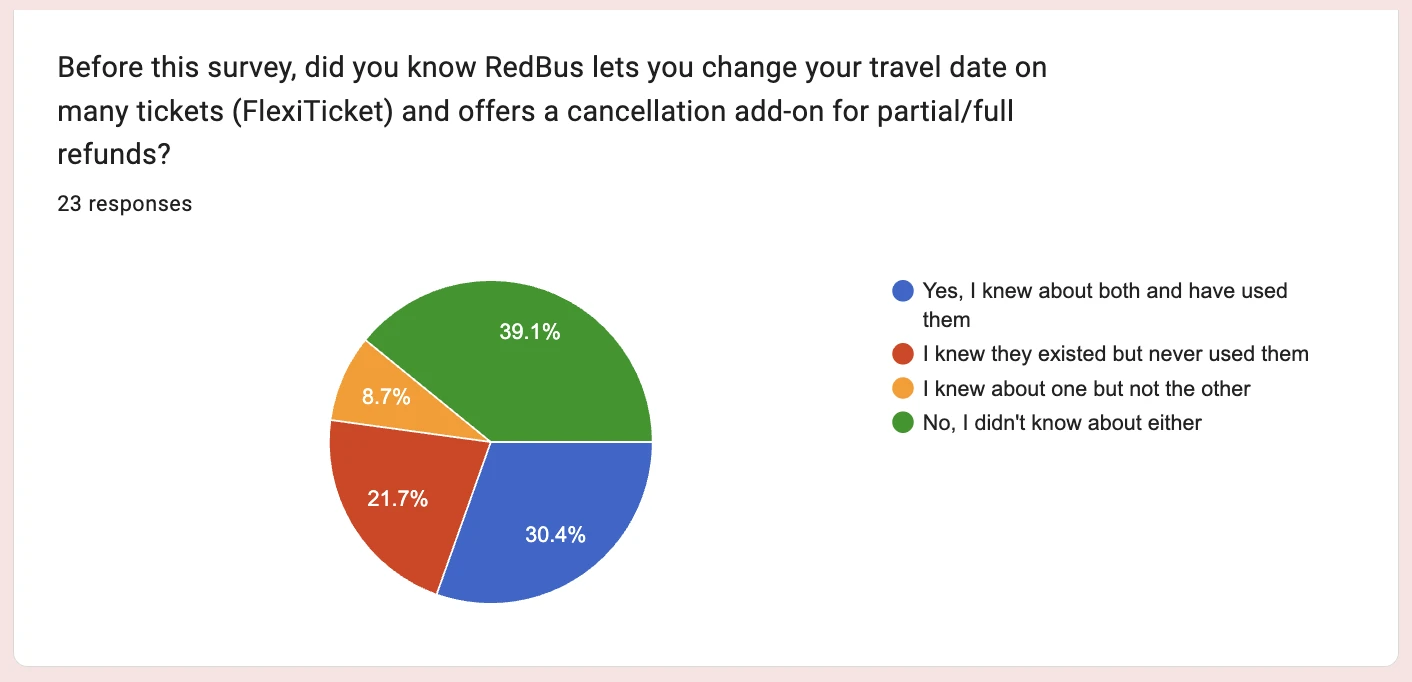
39.1% didn't know about either FlexiTicket or the cancellation add-on
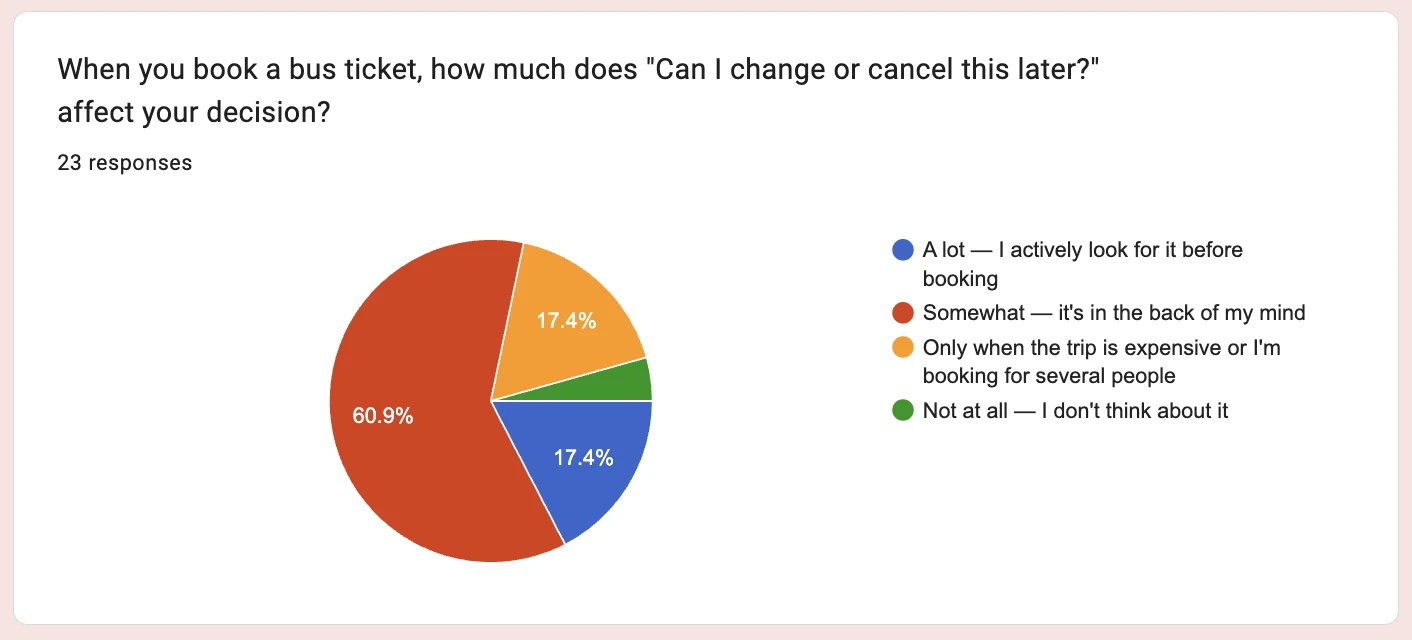
60.9% say “can I change or cancel this later?” is “somewhat, in the back of my mind”
Open text ×2: give a bundle / return discount to encourage booking straight away
Anand: listing card price ≠ actual seat price; must open the bus to find the ₹400 seat
Anand: no written reviews shown, though feedback is collected after every trip
Anand: language barrier, couldn't find the boarding spot, bottle thrown out, friend left behind at a stop
Anand: no washroom or halt information on the platform
Harshraj: order history doesn't show upper vs lower berth
Jaimin: government bus number arrives by SMS at the last moment → walking the depot looking for it
Jaimin: no photos or details for government buses, “it's a gamble”
Prayani: seat-verification popup failed three times
Prayani: solo female blocked from a shared seat only at checkout, after the whole flow
Sai: listing card shows the lowest seater price, not sleeper, “gaslighting me”, forces back-and-forth
Sai: a known boarding stop missing from the app's list
Samarth: boarding address text and the Google Maps pin 800m apart; nearly missed the bus
Samarth: bus skipped an intermediate stop because no passengers were waiting
Samarth: wants a 360° image of the boarding point
Tia: bus number not shared until the last moment, a safety issue her parents ask about
Vivek: operator cancelled the bus a day before, no alternate offered, charged him, refunded only after a complaint
Vivek: won't use RedBus AI, “I don't trust AI with all of the money things”
Anand: the reverse-cities button in the search bar, the stated reason he's loyal
Jaimin: the return flow auto-reversed the cities and offered today/tomorrow quick buttons, “a pleasant experience”
Sai: “step-by-step process is good for me... I don't have to think too much about it”
Prayani: MakeMyTrip's filters, low cognitive load, why she stays
Samarth: RedBus boarding/dropping clarity beats AbhiBus; 1–2★ reviews readable
Vivek: the women-safety filter is “something good that they have”
Harshraj: “it works, it didn't give me any issue till now”
Six clusters. Each carries the tension underneath it and a So what? written from the traveller’s side.
User can't commit to a return date that isn't theirs to set
The date they'd have to commit to is owned by someone or something else
Left with no return booked and waited until an event, a group or a recovery resolved itself, Jaimin, Sai, Prayani, Vivek, Tia, Samarth
User avoids booking at all, because every way of staying flexible costs money
Undoing a commitment costs real money, so they avoid taking the position at all
Skipped the cancellation add-on and simply didn't book, rather than book and risk the 20/40/80% cancellation ladder, Vivek, Samarth, Anand, Tia, Harshraj
User only finds out what waiting cost them after the decision is made
Deferring feels free at the moment of choosing and expensive a week later
Came back to an emptier bus, seat gone, price up, group split across two buses, Tia, Vivek, Sai
User has to start the return search from scratch, because nothing is carried forward
The return is a fresh search later, not a thing already in progress
Re-found the return from scratch days later, sometimes on a different app, and one ₹50–100 pop-up was enough to convert one of them, Harshraj, Jaimin, Sai, Vivek
User carries the unbooked return around for the whole trip
An open return is not free, it occupies them until it's closed
Described booking both as relief, and described the open return as something they kept thinking about mid-trip, Sai, Prayani, Jaimin, Tia
User is guessing which way the fare will move, and acts on the guess
They're making a timing bet with no information, and their beliefs directly contradict each other
One waited on purpose and paid ₹300 for a return against ₹700 for the outbound; two others stopped waiting after concluding prices only rise; one refuses to re-check at all in case checking raises the price, Anand, Sai, Tia, Samarth
Every cluster at the same level: one label, one So what?, one JTBD, and the notes underneath it.
User can't commit to a return date that isn't theirs to set
Return not booked, “how much days I am going to stay there wasn't fixed at that point”
Return deferred, unsure whether he'd stay for a wedding
“Not because of prices but because of clarity over plan”
Family wedding, dates not final, depended on whether he could work from the village → outbound only
Return depended on recovering from a broken leg and on a friend leaving the city
Group, “till the last day it was not final who wants to leave and who wants to stay”
47.8% “My plans depended on other people”
Group trips depend on whether the other person will lock in, or wants to wait for a price drop
Single location → round trip together. Multiple locations → never
“mostly whenever I plan travel the coming back I don't fix it. It's impromptu only”
User avoids booking at all, because every way of staying flexible costs money
Cancellation charge scales 20% / 40% / 80% as the date nears, “so I usually avoid those”
Exam trip, wanted to change, no refund, abandoned the ticket and booked another
Booked early once, wanted to push the date, couldn't, “we regretted it”. After that, always 1–2 days before
Prefers losing the seat at checkout over booking and paying a cancellation charge if his parents disagree
26.1% “I was worried about cancellation”
On change/cancel: “I know there is an option but I just prefer okay this option doesn't exist”
Skips the cancellation add-on solo (₹1500–2000, partial refund anyway); would buy it for a group
Skips the cancellation add-on when the plan is fixed, “jab sab kuch fixed hi hai toh bhai tumko 300 rupe kaye ko dene ka”
39.1% didn't know about either FlexiTicket or the cancellation add-on
Didn't know FlexiTicket existed
Cancellation window “hidden somewhere down there”, not visible while booking
Prefers buses with flexi-ticket / refund options; has used them three or four times
Cancelled for a family emergency, took a partial refund, rebooked the same bus days later
Bought the cancellation add-on and travel insurance on the return, precisely because he was unsure
Would buy it when travelling with parents, “300 rupees as a good ROI for me”
A ₹10,000 flight cancellation loss changed his mind about add-ons when the amount is big
User only finds out what waiting cost them after the decision is made
Booking late meant high prices and no seat of choice; motion sick, ends up at the back
Peak season, return seats simply unavailable; had to wait for a cancellation or an extra bus
21.7% “My preferred seats/buses were…”
Booking later: 39.1% found their preferred seat gone; 30.4% found prices had gone up
Waited a week, long-weekend prices high and preferred seat unavailable
The return then cost ₹1300–1400 instead of the usual ₹1000
Booking later: 39.1% found their preferred seat gone; 30.4% found prices had gone up
Not enough seats left, the group had to split across two or three buses
User has to start the return search from scratch, because nothing is carried forward
Has never used the round-trip option, “I think you are referring to that round trip option, I never used it”
73.9% booked the outbound first and the return later. Only 13% booked together
When the return date is FIXED, 39.1% still book the return separately (39.1% book together, 21.7% depends)
26.1% booked the return on a different app than the outbound
Checked return buses while booking the outbound, got no hits, “I didn't pay much attention”
Uninstalls the app between trips; a marketing push brings him back
A ₹50–100 discount pop-up is what actually triggered the return booking: “that pop-up is what led me”
Open text ×2: give a bundle / return discount to encourage booking straight away
User carries the unbooked return around for the whole trip
On booking both together: “I did feel like halka” (lighter)
Udupi round trip booked together, “I was much calmer and I didn't at all think about the return journey”
Would book both together to secure the seat, “a piece of mind that I have secured my seat for that date”
Asked if he'd still do it without the discount: “then also for me that piece of mind is really important”
Festival trip, “I was always keep on thinking whether I'm gonna stay longer... how the prices are... I don't want to keep anything unknown”
Personally always argued to book together; the group overruled her
Alone with a fixed date she'd book together, “my second thought would be if the seats are not available then what”
Group trips depend on whether the other person will lock in, or wants to wait for a price drop
User is guessing which way the fare will move, and acts on the guess
ThinBooked the return the day before; ₹300 vs ₹700 outbound. Price-drop hack learned from a stranger on a trip
Off-season return, prices low, preferred seat available, nothing changed
Return ended up cheaper (₹1700 vs ₹1900) because demand was low
Believes prices only rise with time, so never waits deliberately
Learned by observation that prices don't drop, “it was mostly stable only, or increased”
Fears repeated price-checking pushes prices up, so avoids checking; screenshots and shares with a friend instead
Wants a Skyscanner-style price calendar: “I'll do that as soon as possible so that I just lock in”
When [situation], I want to [motivation], so I can [outcome]. Six from the clusters, combined into four.
When my return depends on something that hasn't resolved yet, I want to leave for the trip without pretending to know the date, so I'm not inventing a commitment I'll have to undo.
When I might be wrong about my return, I want being wrong to cost me very little, so I can decide now instead of waiting.
When I'm deciding whether to wait, I want to know what waiting will cost me, so the choice isn't blind.
When I come back to book the return, I want to carry on from where I stopped, so I'm not redoing work I already did.
When I'm on the trip, I want the return settled, so I'm not carrying it around with me.
When I don't know which way the fare will move, I want to stop guessing, so I'm not losing money on a hunch.
Holding a return without owning the date
from C1 + C5When my return depends on something that hasn't resolved yet, I want the return handled without naming a date I don't have, so I can get on with the trip instead of carrying it around with me.
Being wrong cheaply
from C2When I might be wrong about my return, I want being wrong to cost me very little, so I can decide now instead of waiting.
Deciding to wait with the price of waiting visible
from C3 + C6When I'm deciding whether to book the return now or later, I want to know what waiting will cost me, so I'm not making a money decision on a guess.
Resuming instead of restarting
from C4When I come back to book the return, I want to carry on from where I stopped, so I'm not redoing work I already did.
“I want to be wrong about my return date without it costing me much.”
[User segment] struggles with [problem] because [root cause], which means [implication for design]. One per final JTBD. Root cause and implication for design are the designer’s interpretation, the segment and the problem come straight from the notes.
Holding a return without owning the date
from C1 + C5Intercity round-trip travellers whose return depends on an event, a group or a recovery that hasn't resolved struggles with leaving on the outbound with no return at all, and then carrying that unbooked return through the whole trip because RedBus has only two states for a return, bought, or nothing, and both require a date the traveller doesn't own. There is nothing to commit to that matches what they actually know about their trip, which means the product needs a third state: a return they can hold using what they do know, their constraint, rather than what they don't.
Being wrong cheaply
from C2Travellers who think their return plans might still change struggles with choosing not to book at all, rather than book and risk what it costs to get out because the price of being wrong is set by a 20/40/80% cancellation ladder and a paid add-on, and both are priced and explained after the decision point, so the cheapest way to stay flexible is to take no position at all, which means the cost of being wrong has to be knowable and small at the moment of committing, not discoverable afterwards.
Deciding to wait with the price of waiting visible
from C3 + C6Travellers deciding whether to book the return now or later struggles with deferring on a hunch, then discovering the price a week later, a lost seat, a higher fare, a group split across two buses because RedBus holds the seat and fare history for every route and shows none of it at the moment the traveller is choosing to wait, so a decision with real money on it is made blind, and travellers reach directly opposite conclusions from the same experience, which means the cost of waiting has to be visible while they are deciding to wait, and stated as information rather than as urgency.
Resuming instead of restarting
from C4Travellers returning to book the return leg days after the outbound struggles with repeating the entire search from zero, with 26.1% of the survey finishing it on a different app because the return is not an object the product holds. The route, operator, seat and boarding point already chosen are not carried forward, so the second session is a first session again, which means the return has to persist as something already in progress, so coming back to it is resuming rather than restarting.
What survived contact with the research.
A traveller who doesn’t yet know their return date has no usable way to keep a return on RedBus.
The flexibility already exists, eligible buses allow a free date change, and a cancellation add-on is sold at checkout. But it is offered as a property of a bus, discovered incidentally, and it never enters the moment the return is actually decided. Nothing in the flow asks what the traveller does know about their trip; it asks only for a date.
So they leave the session with nothing and repeat the entire search days later, often for a worse seat or a higher fare.
The barrier is not intent, not awareness, and not a missing feature. It is that the product’s flexibility is shaped as an attribute rather than as a way to book.
Four components, one page. Every one traceable to a note.
Guardrail: outbound-booking completion stays at or above 95% of its pre-change baseline. Concept target; no live baseline exists.
What the design decision connects to, and what it compounds. Both need the solution to exist, so they sit after the brief rather than with the business lens at the start.
Ask which days they could come back, book one of them and let it move once, in the same session
In-session return-attach rate
% of one-way sessions that add a return before payment
Round-trip attach rate · commission per session · return-leg leakage 26.1% · cancellation and support contacts
Journeys booked per active traveller per year
A movable return gives the traveller a reason to open the app during the trip, with no notification and no marketing spend. The move flow is the loop’s retention point.
The second commission lands in the same session, at no extra acquisition cost.